


Fructal
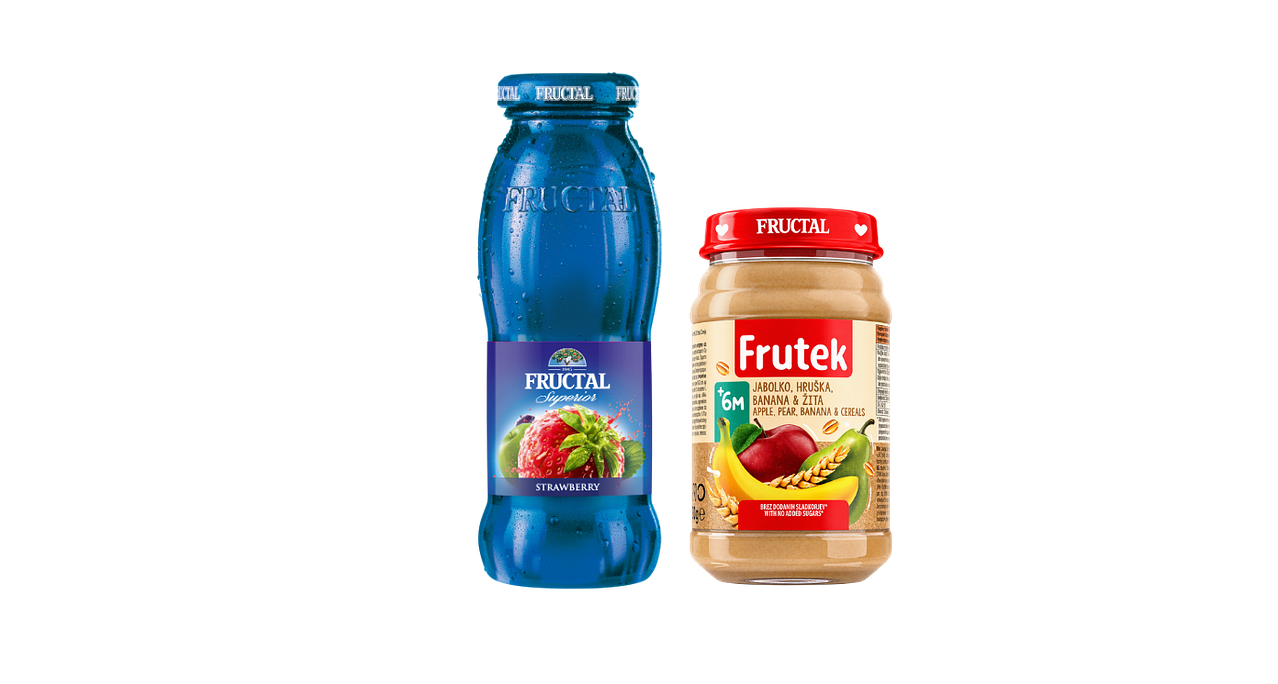
10/2026: The combination of tradition, quality and distinctive design is a powerful formula for creating products that remain recognisable for generations. Fructal embraced this approach several decades ago. Best known for its juices and baby food, Fructal specialises in fruit-based products. Operating in a competitive market, they recognised the need to stand out while protecting the quality of their products and, together with Vetropack, found a solution that addressed both. Examples include the Blue Bottle, developed exclusively for their juices, and the distinctive packaging of Frutek, the company's well-known baby food brand. Over the years, both have become visual signatures of the brand. But their role goes far beyond aesthetics.
Fructal’s story began in Ajdovščina, Slovenia, in 1945, when a small team started producing fruit spreads in a former textile factory. Over the following decades, the company expanded its production and became one of the leading fruit juice producers in former Yugoslavia. During this period, the company also entered the baby food segment and created a brand that would be remembered by generations. Since 2011, Fructal has been part of the Nectar Group, which operates across more than 12 FMCG categories and has a portfolio of more than 600 products.
A bottle that makes Fructal stand out
Despite growth and change over decades, some things at Fructal have remained constant: consistent quality, sustainability, innovation and investment in technological innovation. Alongside these values is a partnership with Vetropack.
‘We have been working with Vetropack for more than two decades, and the cooperation covers several parts of our portfolio. The most significant partnership concerns the Blue Bottles, the bottles for our Fructal Superior brand, although we also cooperate in other segments, such as syrups, alcoholic beverages and baby food,’ says Irena Vujović, Senior Brand Manager at Nectar Group.
The Blue Bottle was introduced to the market in 2003 and was developed exclusively for Fructal. The idea was to make a bottle that stands out and is instantly recognisable. The blue colour was a natural choice since it had already been a defining colour of the brand for many years.
Vetropack's role in the story was to turn Fractal's idea into a technically viable solution for glass packaging. Creating the bottle presented a specific technical challenge at the time, since Vetropack had not produced blue glass before then. An additional issue was that the quantities were too small to colour an entire furnace. It was then that Vetropack installed technology for feeder colouring on one production line, which has remained an important part of production to this day. Since then, Vetropack has introduced colours such as light blue shades, light green, turquoise, UV flint, etc.
However, visual identity is not the only advantage of the blue bottle. The darker the bottle, the better its contents is protected from UV rays. In this case, the blue colour of the glass contributes to product protection by shielding it from exposure to light.


«For our products, this means reducing potential degradation of the liquid over time and helping preserve nutrients such as vitamin C.»

Over the years, the Blue Bottle has continued to build recognition across markets. Although it established its identity in Slovenia, Fructal Superior is now present across the Adriatic region, the Czech Republic and Italy, as well as in markets further afield, including the USA, Canada and Australia.
‘The bottle has remained unchanged since its initial development. However, some variations have been made in the meantime – for example, the same bottle in flint (for ice tea) or a flint 330 ml version for some of Fructal's legendary juices like Pingo and Dvojni C,’ says Goran Vurnek, Sales Representative at Vetropack Straža.
The Blue Bottle is produced in significant volumes, with 347 million units manufactured since 2003 – initially at Vetropack Straža, and now in Nemšová, where production was relocated to take advantage of the site’s existing blue glass production and enable efficient manufacturing of Fructal bottles. Maintaining this long-term supply requires careful coordination, particularly because the production of coloured glass needs to be planned well in advance. This is where the long-standing relationship between Fructal and Vetropack adds value beyond the physical packaging itself.
Glass that has grown with Frutek
The Vetropack–Fructal partnership is also reflected in the baby food portfolio, where years of cooperation have resulted in equally recognisable packaging. One of the region’s best-known brands in this segment, Frutek, was launched back in 1974. The brand started with juices for babies and young children, and eight years later entered the baby food puree segment. Glass packaging emerged as a natural choice for the category. Although product quality depends on the entire production process, glass is an important part of that system because it helps ensure that what parents open at home is as close as possible to what was originally produced. Today, glass accounts for around 85% of Frutek’s packaging.
‘Glass has been an integral part of the Frutek brand since its beginnings. Over the years, we have modernised the design, but we have retained glass as the primary packaging material because of its ability to preserve product quality and safety,’ says Vladimir Tomašević, Nectar Group Marketing Manager Nectar.
Like the Blue Bottle, the Frutek bottle is designed to stand out. It is recognisable by its distinctly stepped shoulder with layered horizontal contours, a characteristic feature that ensures the packaging is associated with the brand. Although the overall packaging design was refreshed in 1999 and again in 2014, the characteristic shape was retained because it is closely associated with the Frutek brand.


Looking to the future
Given the role it plays for the brand, glass will continue to play an important part in Frutek's portfolio and, at the same time, packaging will continue to evolve to meet changing consumer and market needs. ‘The future development of packaging will continue to focus on three key priorities: product safety and quality, consumer convenience and sustainability. While we do not comment on individual future product or packaging launches, our commitment to providing safe, high-quality products in packaging that consumers trust remains unchanged,’ Tomašević concludes.
In this context, Fructal's partnership with Vetropack takes on a broader meaning. It is not only about creating packaging for a product. The long-standing partnership between Vetropack and Fructal demonstrates that packaging, when developed in collaboration with a brand, can contribute to product quality while becoming a vital part of the brand’s identity.
