


MAKAvA
09/2025: A fashionable drink that’s pleasantly stimulating, vegan and fairtrade – doesn’t taste too sweet, and comes in a sustainable glass bottle? No such thing exists? Oh yes, it does! MAKAvA ice tea – brewed with real mate leaves from Argentina – has already conquered the club scenes of Vienna, Munich, Berlin and Zurich, and now it’s gradually making its way into retail outlets. Vetropack has supplied the glass packaging for MAKAvA since 2017.
The MAKAvA success story began more than 20 years ago in a shared student flat. Future company founders Jan and Michi, together with their friend Klaus, were experimenting with their own drink for a party. The ingredients: mate extract (which tastes very bitter on its own), honey, and lemon. The Polynesian kava root, which originally gave MAKAvA its name, is no longer included because it became a prescription-only product in Austria back in 2001. It was replaced by the mate plant, which the friends discovered during a trip to South America. Even today, ‘MAKAvA delighted ice tea’ – as the brand name reads in full – still sources its mate leaves directly from Argentina: in each bottle, there are 10 grams of this plant which contains caffeine. The whole venture really took off in 2005 with a development loan from the Center for Applied Technology (ZAT) in Leoben. Nevertheless, it was not until 2012 that the successful MAKAvA product – regional, sustainable, organic – reached the market in its current form.
“Good things take time,” says Klaus Krivacek. He has been part of the management team almost from the outset, and is responsible for supra-regional sales across Germany, Austria and Switzerland. “After the success of Club Mate from the late 1990s onwards, many suppliers (including some large ones) tried to jump on the mate bandwagon. But only a very few of them achieved long-term success.” MAKAvA is unique on the market because it is not a lemonade – although it is ready to drink; nor is it too sweet, so it is attractive to a broad consumer group. There are similar drinks in South America, where (as Krivacek points out) mate comes right after Maradona and Messi. “And with our focus on organic products, of course, we’re the perfect choice for health- and climate-conscious people!”
Sustainability is the top priority
Krivacek’s studies of energy and environmental technology have given him a keen eye for sustainability at MAKAvA: “Our ice tea is vegan and certified organic, and our production is resource-efficient. What’s more, we accord high priority to sustainable business practices and corporate social responsibility,” he reports. The CO2 generated in the value chain has been fully offset since 2018; MAKAvA also uses sustainably produced labels and, thanks to its partnership with beverage producer APO Fruchtsäfte GmbH, has access to natural spring water that does not need to be pumped or chemically treated.
Sustainable glass packaging adds the perfect finishing touch to MAKAvA’s exemplary ecological impact.

«The glass bottle was important to us right from the start. To reduce our carbon footprint even further, we switched from a German supplier to Vetropack Austria in 2017. As well as shortening transport routes, this step has given us a packaging supplier with a wholehearted commitment to sustainability.»

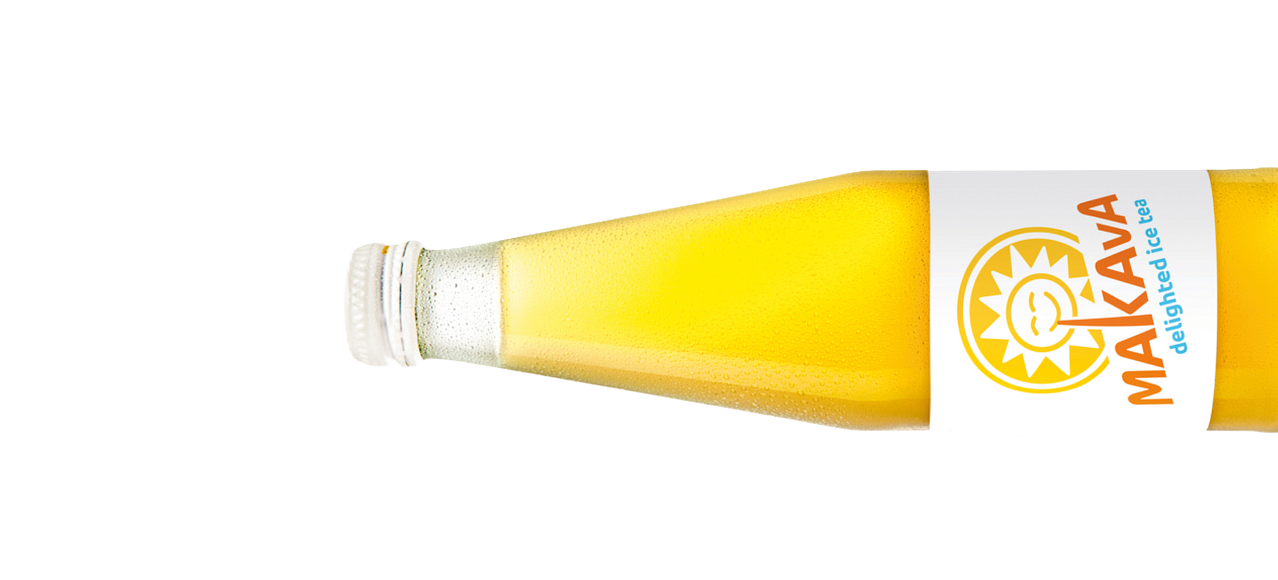
The move to Vetropack left the design of the 330-ml bottle largely unchanged: it is suitable for hot filling and is resealable, featuring a long, narrow neck – as well as the large label with the distinctive sun logo, modelled on the Argentine flag.
From clubs to the catering trade, and onwards into supermarkets
MAKAvA originally started out in the catering trade and on the club scene, but now the ratio of hotels, restaurants and catering (HoReCa) customers to food retail is around 50:50. MAKAvA offers its ice tea in reusable bottles for the catering sector; for the retail trade, it is also available in a non-returnable bottle. Vetropack now supplies around four million bottles per year to MAKAvA and since 2017, it has supplied approximately 27.5 million glass containers.
The glass containers are filled, or cleaned and refilled, at APO Fruchtsäfte GmbH. APO used to stand for ‘Adi presst Obst’ (‘Adi presses fruit’) but today, the acronym stands for ‘Alkoholfrei – Preiswert – Original’ (Alcohol-free – Affordable – Original). This Carinthian family business now employs a workforce of 18 and has evolved from a pressed fruit processor into a regional supplier of high-quality fruit juices, lemonades and mineral waters. APO has tapped into contract filling as a second business segment, and the company offers a high-quality filling plant for glass and PET containers in Millstatt am See. Most of the energy for production comes from the company's own photovoltaic system.
“APO gave us their vigorous support – especially at the beginning, but also going forward,” Krivacek continues. “For example, they helped us with process development on issues such as container size, quantities, filtration, brewing times, and so on. We also worked together to optimise processes when we entered the non-returnable market for the retail sector – APO, too, is a long-standing customer of Vetropack.”


New markets and even less CO₂ – in partnership with Vetropack
And how about the future? After many years of healthy organic growth, MAKAvA has also felt the impact of the coronavirus pandemic. The catering sector is still struggling and has not yet returned to its previous level, especially in rural areas. This means that MAKAvA needs to tap into new markets. Expanding the product range and reducing the ecological footprint are also key issues. “The German and Swiss urban regions in particular still have potential – think nightlife catering! – and the same is true of the retail sector across the board, of course,” Krivacek notes. However, a cautious and targeted approach is required here – there is considerable competition and a certain degree of market saturation, even for in-vogue drinks.
In the medium term, the company also wants to switch to reusable packaging in the retail sector – and here too, it can rely on Vetropack’s expertise to achieve its goal.
Klaus Krivacek concludes: “We’re reviewing all these steps most carefully, and we’re very pleased to have Vetropack as a regional and innovative packaging partner who can help us to advance even further, especially when it comes to sustainability. Their quality, punctuality and the reliability of their deliveries are very good, and we look forward to continuing our successful collaboration with Vetropack going forward.”

