


Schenk
04/2026: Schenk Suisse SA is one of the established players in the European wine market. With renowned brands from several historic wine houses, the company has built a strong market position over decades. Today, Schenk is investing heavily in sustainability and in a portfolio that conveys not only wine, but also values. This includes bottles that are both economically and ecologically sustainable. Together with Swiss glass packaging specialist Vetropack, the company has significantly reduced the weight of the iconic bottle used for its flagship brand, 'Murailles'.
More than 100 years ago, in the hills of the canton of Vaud, a story began – one shaped by a passion for wine and a tireless pioneering spirit. In 1893, cooper Charles Schenk founded a small company in Rolle: Schenk Suisse SA. Just three years later, he presented a legendary 23,500-litre barrel at the National Exhibition in Geneva – a clear sign of things to come. What began as a local enterprise soon grew into an empire.
Today, Schenk Suisse is still a family-run company with more than 300 employees in Rolle and at other locations. The owner family is now in its fourth to fifth generation of running the group. Its heritage includes exceptional vineyards in Switzerland, France, Italy and Spain. Twenty-five renowned brands originate from the four historic wine houses of Bolle, Badoux, Obrist and Testuz. Among Schenk Suisse’s many flagship brands are Château Maison Blanche, Domaine du Martheray and Murailles.
Ecological winery sets new standards
Schenk Suisse places sustainability at the heart of its vision for the entire product range. The company has recently made significant investments in sustainable infrastructure. This includes a state-of-the-art large-scale winery equipped with solar panels and operated entirely without fossil fuels, built in 2025 at Schenk’s headquarters in Rolle. The winery is constructed almost exclusively from natural, recycled, and locally sourced materials. Vaud spruce was used for the structure, the walls are insulated with cork, and recycled glass provides insulation in the foundations.
The winery also takes advantage of its natural hillside location. The wine is moved by gravity, minimising the use of pumps and helping to preserve its quality. The new bottling plant is also part of the overall ecological concept, with a focus on efficiency, energy saving and sustainability. ‘Our consumers expect wine and packaging to convey the same values,’ explains Samuel Bühler, procurement specialist at Schenk. Sustainable packaging is therefore a prerequisite rather than an option.
600 tonnes less glass – every year
‘Our goal is to reduce our carbon footprint along the entire value chain by 2030 – from the wine to the bottle,’ says Bühler. Glass packaging designed for less weight plays a key role in achieving this. Schenk Suisse has therefore revised its portfolio and introduced lighter wine bottles. The impact of this weight reduction is measurable: Schenk now saves around 600 tonnes of glass each year across its entire portfolio. This corresponds to about 33 truckloads, or roughly 2.5 million wine bottles. Overall, the group has reduced its glass consumption by ten per cent.


«Aigle les Murailles is Switzerland’s best-selling wine and, with more than a century of history, a real success story.»


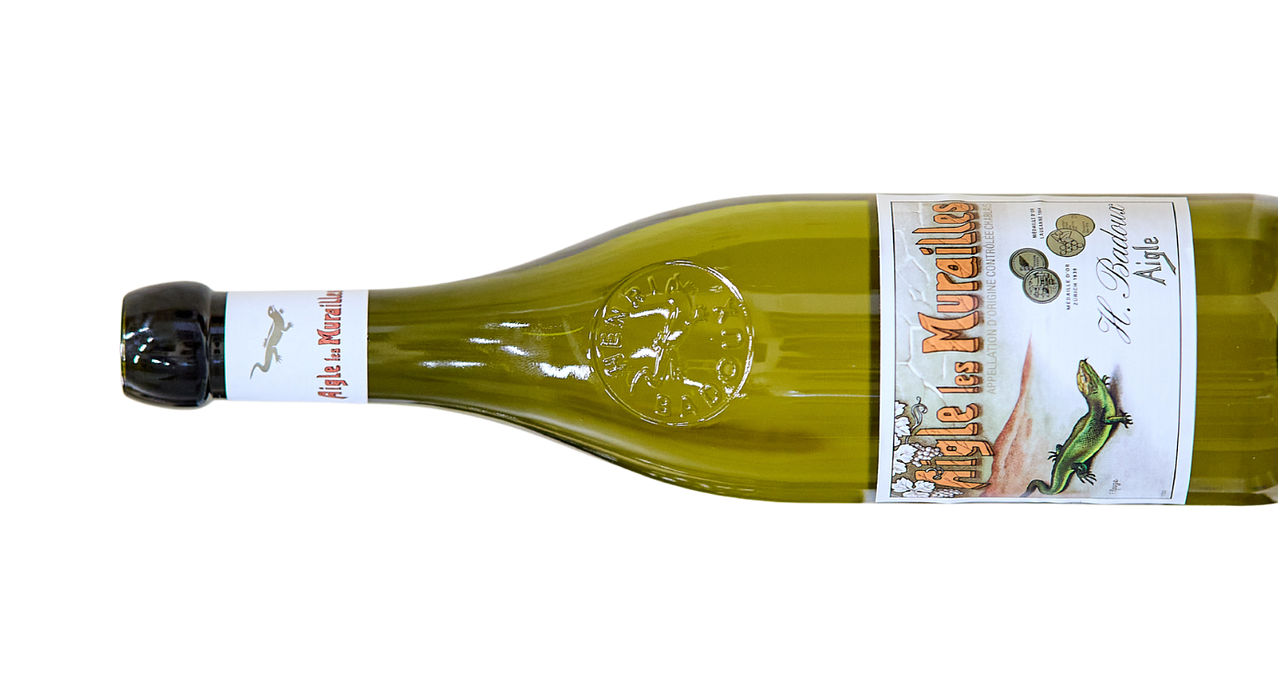
However, significantly reducing weight while preserving the characteristic design of each brand proved a challenge. This balancing act is best illustrated by the iconic bottle of the Murailles brand. ‘Aigle les Murailles is Switzerland’s best-selling wine and, with more than a century of history, a real success story,’ says Miryam Voide, Murailles brand manager. Samuel Bühler adds, ‘We have clearly prioritised certain brands – and Murailles is one of our most important.’ After all, it is not just any wine. Its story began in 1908, when Henri Badoux – founder of the winery of the same name – showed great foresight by acquiring the vineyard plots in Clos des Murailles. Ten years later, the Aigle painter Frédéric Rouge completed the picture. He created the label with the lizard, inspired by the nature of his homeland – a design that remains unchanged to this day. Since 1919, the wine has stood for Vaud’s winemaking tradition and craftsmanship, embodying consistency in a changing world.
The bottle as a carrier of identity
‘Form and aesthetics are crucial for us because both create recognition. The label designed by Frédéric Rouge has long been a fixed point of reference in Swiss wine culture,’ says Voide. The green lizard is almost always present – only in the 1960s did it briefly disappear from the label for the US market. This was because customs officials classified the animal as potentially harmful.
Another key feature of the brand is the 0.7-litre bottle with its distinctive finish. Schenk worked with Vetropack to overcome the challenge of adapting it. Using state-of-the-art 3D models and precision glass development, the bottle weight was reduced from 602 to 430 grams – without any major changes to its distinctive design.
‘Of course, there are some technical limitations,’ says Christine Arnet, Sales Director at Vetropack. ‘But thanks to our development processes, we were able to meet Schenk’s aesthetic requirements while significantly reducing weight. We are delighted with how familiar the new bottle looks. The visual differences compared with the previous version are barely noticeable.’


Open to new moments of enjoyment
Meanwhile, Schenk is looking ahead. While traditional wine consumption in Europe is declining slightly, non-alcoholic and low-alcohol offerings (NOLO) are growing significantly. With Murailles No.7 blanc, the company is launching a semi-sweet wine with reduced alcohol content – fruity, light, and accessible to new target groups. ‘For us, market leadership means always staying one step ahead and adapting to changing consumer habits,’ says Miryam Voide.
For Schenk, Vetropack was the ideal partner for this project. The two Swiss companies have been working together for more than a century – based on trust, experience and technical expertise. This collaboration demonstrates that sustainable packaging design is not a compromise, but progress – progress that combines heritage, craftsmanship and environmental awareness, allowing a Swiss wine legend to move more easily into the future.
