


Artesana
12/2025: Artesana, a young company based in Tecuci, Romania, is winning international awards one after another with its sustainably manufactured products containing cow's and goat's milk sourced from regional producers. Since 2023, Swiss manufacturer Vetropack has supplied the sustainable glass packaging for whole milk, cream cheese, yoghurt and kefir from its site at Chişinău in the Republic of Moldova.
During a trip to the Spanish region of Catalonia, Daniel Donici experienced one of those moments that can change an entire life: he was so impressed by the flavour of a hand-made cheese he was tasting that he resolved: I want to be able to do that too! The ‘I’ became a ‘we’, because Daniel’s wife Alina was soon enthralled as well. That was back in 2007. Neither of them had any previous experience in this field, so you could say that they plunged headlong into the adventure. Their vision was clear from the outset: to produce milk and dairy products of outstanding taste with convincing health benefits.
Nowadays, Artesana is a brand that is held in equally high regard by customers and industry watchers. Milk, cheese, sana – a Romanian variant of buttermilk – yoghurt and kefir, all from the small town of Tecuci in eastern Romania, have regularly won awards from international media and industry forums ever since the company was founded in October 2012. Most recently, Artesana was honoured as ‘Artisan Dairy Innovator of the Year’ for 2025 by Global Brands Magazine. What makes Artesana’s dairy products so unique? Although oat and soy milk are increasingly available in Romania, Artesana is taking a different approach, as General Manager Sergiu Mulțescu reports: ‘The vision is – and remains – to preserve the whole milk flavour: no additives, and the absolute minimum of industrial processing. This means that as far as possible, we take nothing away – nor do we add anything.’
Milk for Artesana comes exclusively from small and medium-sized farms in the region. As a genuine natural product, it tastes slightly different depending on the season, with a fat content varying between 3.5 and 4.2 percent. This is because the animals are given different feed in summer and winter. Around 40,000 litres are produced every day. The milk is pasteurised gently, meaning that it is heated at lower temperatures using optimised processes to preserve vitamins, proteins and natural fatty acids. Also, because it is not homogenised, a natural layer of fat – known as cream – forms on top of the milk. The result: high-quality whole milk, from both cows and goats, containing no additives whatsoever, as the basis for outstanding dairy products.
Glass: the ideal ambassador for artisanal production
The ‘milk artisans’ at Artesana, as they call themselves, see no alternative to glass as a packaging material. Mulțescu again: ‘We don’t just view this as a question of aesthetics – above all, it’s about product quality: glass is the only packaging material that doesn’t react with the contents, so it preserves the fragile ingredients and qualities of our products. Transparency is another critical issue for us: customers can see what they’re getting straight away – the cream that settles at the top of the bottle, for example.’ And as a material that’s 100 percent recyclable, glass is also very sustainable – so it’s a perfect fit for the Artesana brand.
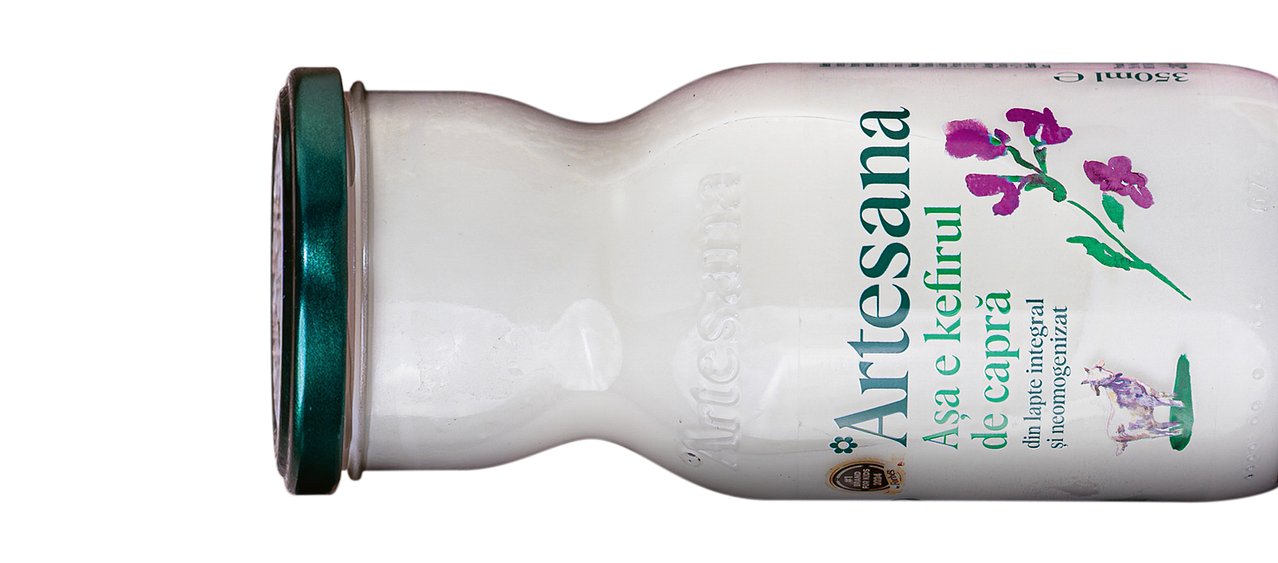
Another striking aspect is the look of the bottles (both 1 litre and 350 ml): their concave design with a wider opening gives them an attractive shape, and also ensures that the cream does not stop the flow of milk. ‘The round, clear shape harks back to the past, representing values that are particularly important to us – such as simplicity, honesty, and diligence,’ Mulțescu emphasises.

«Last but not least, Vetropack’s glass containers feature two inscriptions on the bottom that make them even more unique: the brand name ‘Artesana’, of course, and ‘artizanii laptelui’ (in English: ‘milk artisans’).»


As the business grew and continued to develop, Artesana switched to Vetropack, the Swiss glass packaging manufacturer, in 2023. As well as over 2,500 shops in Romania, the company is supplying more and more outlets in Europe (in countries such as the United Kingdom, Germany and Belgium); the Republic of Moldova was added to the list in 2025. The collaboration with Vetropack began with a 330-ml glass jar and now, it includes five different containers (two bottles and three jars); volume is set to reach around eight to nine million glass containers in 2025. The range comprises:
- 1-litre bottle for fresh cow's milk (including organic)
- 350-ml bottle for sana (made from cow's or goat's milk, including organic), kefir (made from cow's or goat's milk, including organic) and drinking yoghurt
- 300-g, 200-g and 160-g jars for natural yoghurt, cream cheese, sour cream, fruit yoghurt, and other products
‘In turbulent and economically difficult times with trade barriers and inflation, Vetropack offers us major advantages such as reliable deliveries, consistently high quality, and flexibility in the face of changes and innovations,’ Mulțescu points out. He also recalls being impressed by the speed with which Vetropack was able to implement the existing glass containers for Artesana. Vetropack’s site at Chişinău in the Republic of Moldova offers the advantages of geographical proximity and correspondingly favourable logistics, as well as the option of flexible production for smaller batch sizes.
Venturing into new territory together – with lightweight glass as an option
Artesana has big plans for the future: it intends to expand its yoghurt and kefir segments, and also to broaden its range by adding new products specifically for children. A third production line is planned to support international growth. And when it comes to packaging too, development is still ongoing – as Mulțescu reports: ‘Lightweight glass is also an option for us in the future, so we can become even more sustainable and resource-efficient. What’s more, modular packaging solutions are of interest for our international business. We really see our collaboration with Vetropack as an opportunity for co-creation: not only in terms of the glass containers themselves, but also as regards reusable solutions and – by no means least –educational initiatives, focusing on topics such as recycling and environmental responsibility.’
Artesana has already proven how seriously it takes this last issue: the ‘Label Explorers’ schools project was all about food labelling and how to read ingredient information correctly. It reached over 25,000 pupils and teachers throughout Romania; during the course of the project, naturally, they also gained an awareness of what distinguishes a largely natural product from an industrially manufactured one.

